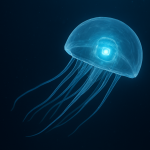



Amidst the global buzz of robotics innovation, one discovery has emerged that feels almost magical: biomimetic jellyfish robot.
Developed by Northwestern Polytechnical University (NPU), China, this robot blurs the lines between biotechnology and intelligent mechanics — finely mimicking the natural movements of deep-sea jellyfish.
Mimicking Nature to Explore Technology
With a diameter of only about 12 cm and heavy 56 grams, this jellyfish robot is driven by a system hydrogel-based electro-hydraulic actuator, which allows for expansion-contraction motion like a real jellyfish.
Each time it “expands,” water is pushed out — creating natural jet style which pushed his body forward.
Its main advantage lies in efficiency:
- Power consumption only 28.5 milliwatts,
- Equipped with a mini camera + AI chip for underwater analysis,
- Transparent and silent, making it barely visible in the deep sea.
With capabilities like these, the jellyfish robot is not just a machine — it is a manifestation of science that imitates the grace of nature.
Ocean Exploration with a Touch of Stealth“
One of the main challenges of underwater exploration is intervention in natural ecosystems.
Propellers, vibrations, or artificial lights often disturb sensitive marine life.
Jellyfish robots present a nearly “intrusive” solution.
Moving softly, transparently and silently, this robot can be used for:
- Monitoring sensitive marine ecosystems,
- Undisturbed coral and marine life observation,
- Inspection of underwater structures such as oil pipes, cables, and platform foundations.
In this way, biomimetic technology not only imitates nature — it also make peace with nature.
New Paradigm: Biomimetics and Energy Efficiency
The biomimetic approach opens up a new paradigm:
Instead of forcing machines to conquer nature, we learn from how nature works.
This jellyfish design proves that:
- Natural movement is more energy efficient compared to the propeller system,
- Soft structures are more adaptive against water pressure and current,
- Organic design actually increases mechanical efficiency and environmental safety.
The jellyfish robot is a perfect example that future solutions don't have to be clunky and noisy — sometimes they can be. soft and quiet.
For Ezra Robotics, the emergence of the jellyfish robot brought profound inspiration about new direction of innovation:
- Adaptation for Industry and Environment
Similar technology can be adapted for:- Inspection of water channels, dams and underwater pipelines,
- Marine environmental monitoring,
- Explore vulnerable areas without disturbing the habitat.
- Focus on Efficiency and Sustainability
Low energy isn't just about efficiency — it's also about sustainability.
Ezra can take this lesson to develop a robotics system that energy-saving, adaptive, and environmentally friendly. - Research and Collaboration
The biomimetic approach opens up opportunities for collaboration between industry, universities, and environmental institutions.
Ezra Robotics can be a bridge between pragmatic engineering And biological inspiration.
Challenges Worth Considering
While impressive, the development of jellyfish robots still faces challenges:
- Resistance to deep sea pressure,
- Limited underwater data communications,
- Autonomous navigation without GPS,
- Scalability and cost of mass production.
But like all great innovations, challenges are the door to progress.
Nature as a Technology Teacher
The biomimetic jellyfish robot is a symbol of a new revolution in robotics — a revolution that imitate nature, not oppose it.
He teaches us that true sophistication lies not in strength, but in harmony.
For Ezra Robotics, this inspiration opened up the space to create robots that were not only intelligent and efficient, but also in harmony with the world around him.